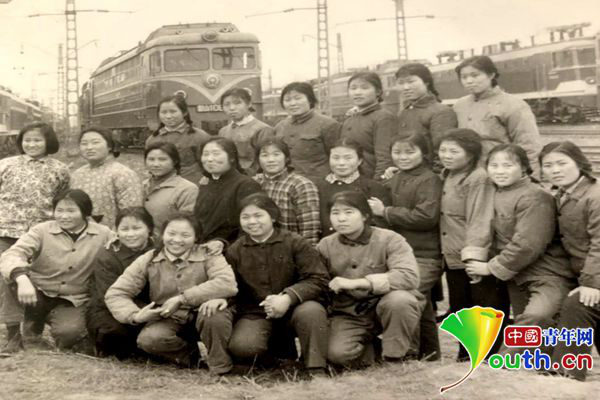
The first batch of female drivers of electric locomotives in 1973. [Youth.cn]
Three female members from China's first batch of drivers of electric locomotives, appointed in 1973, recently shared their experiences with journalists and spoke about working on one of the most difficult rail lines to operate in the country.
Yang Xianmei, Hu Xuezheng and Bai Yane all worked on the line that then connected the city of Baoji, northwest China's Shaanxi, with Chengdu in south China's Sichuan Province, a railway that runs 669 kilometers, cutting through southwestern China's rugged mountains with more than a thousand bridges and over 300 tunnels.
Proficient in Special Field
Recalling when she first boarded the locomotive, Yang said that sort of feeling would never be forgotten in her lifetime. "Through the windows, I could see the winding railway hovering on the towering top of the high Qinling mountains, with wheels crashing and whistles alerting," said Yang, still totally soaked in the joy as she did decades ago when she started driving locomotive for the very first time.
As the first batch of female drivers of the electric locomotives, Yang said: "We often met some patrol men and track maintenance workers during the course of operation, and they usually gave us a thumbs-up to encourage us," Yang said.
From Baoji station to Qingling station, there are five train sections stretching over 42 kilometers through 48 channels, with the highest ramp rate reaching 33 percent, which was regarded as the most difficult rail line to operate at the time.
"Once, I was driving the locomotive with my instructor when suddenly there was smoke arising in the carriage passage, and I was immediately sent to check for malfunctions," Yang recalled.
Inexperienced as she was at that time, Yang could not fix the problem until her instructor gave her a helping hand.
That incident set Yang thinking. She came to realize that driving a locomotive takes not only proficiency but also precision in the profession, because it is a matter of life and death, a huge responsibility that must be taken seriously.
From then on, Yang began to work hard in the field. However, as she had barely received junior high school education, the advanced mechanical learning was still a difficult task for her.
With her strenuous efforts, she recited all the relevant rules and regulations, and drew the circuits of the electric locomotives numerous times.
Meanwhile, she also tried her best to figure out all the applicable solutions in case any sudden accidents should occur.
Yang has overcome many technical problems during the course of operation, whist she is more proficient in changing the couplings and picking up the flue pipes, as compared with many male counterparts on the staff.
Three Generations
Hu Xuezheng had been longing to work in the railway system since she was a little child, as her father was a railway worker. In her childhood memory, Hu's father would go to build railways in the Qingling Mountains every morning and would not come back until night.
Hu recalled, "My father often said when the railway was built, there would be no more difficulties for us to go out of the mountains."
Therefore, since then Hu had dreamed to be the driver of the electric locomotive. And yet, at that time, there were no female drivers.
Her opportunity came in 1973 when a group of female workers first emerged in the electricity industry. They were treated as role models and many other industries also started hiring women.
Under such circumstances, the Baoji Electric Locomotive Section also decided to recruit a batch of female drivers of the electric locomotives. Hu enrolled and was successfully selected as a female driver.
However, it is by no means an easy task to be a well-qualified electric locomotive driver. As many accidents and challenges occurred during the process of driving, she had to gone through numerous trails and errors.
"Once, I was driving the electric locomotive through a stretch between Huangniupu Station and Qinliing Station, I sounded a whistle when approaching the end of tunnel, which frightened a cattle feeding on grass alongside the railway. All of a sudden, it fled onto the rail track in front of the train," Hu recalled.
"It was too late for me to stop the locomotive, and the cattle was crushed. Later, I made a quick disposal of it with the assistant driver," she added.
Though no further damage was caused, after the ordeal, Hu felt terribly scared. Moreover, she began to develop a deeper understanding of the importance of safe driving for all the passengers.
So, she became more cautious on driving and actively discussed with colleagues about issues concerning improving regulations or making strict regulations for the disposal of accidents.
Since then there has been no similar accidents in the railway, and her special persistence and cautiousness supported Hu to grow into a real driver.
Fifteen years ago, Hu's 23-year-old daughter also joined her in the railway occupation. Since then, the family has been rooted in the railway line for a lifetime.
"Working in the railway has been the honor and dream of our family for three generations," Hu said.
Persistence
Built in memory of Bai Yane, the Baoji-Chengdu Railway mainly covered the remote mountainous areas where nearby villagers were too impoverished to buy a ticket.
The continuous mountains impeded the villagers' way off the mountains, so in order to catch the only train, once a day, many villagers often walked several kilometers to get to the nearby station, with heavy baskets on their backs.
"However, at that time, many villagers could not afford the ticket fare of merely a few yuan, which often saddened me," Hu added.
Moreover, the backward environment in mountainous areas also made it difficult to see a doctor.
"Once, there was a villager who suddenly fell ill. However, the ambulance could not get into the mountains, so the Train Dispatch Room managed to allow for one minute of waiting in time for the train to transfer the patient," Hu recalled.
At that time, Hu was well aware of the importance of the railway for villagers, which also supported Hu to work in the mountains for many years.
The construction of the Baoji-Chengdu Railway promoted nearby economic development, whilst many villagers, who previously lived by means of mountainous resources, started agritainment businesses.
With the local specialties of the mountainous areas sold to various parts across the country, the villagers along the railway gradually got rid of poverty by developing tourism.
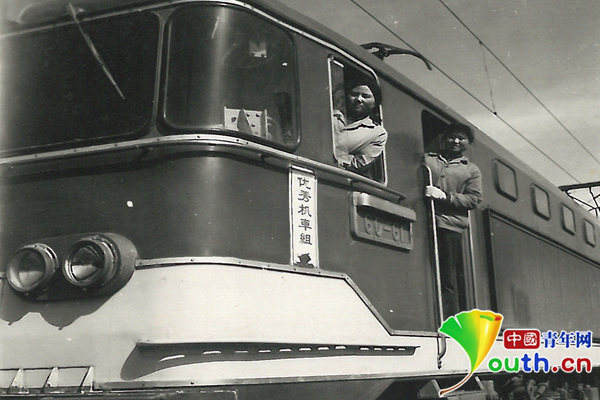
Female drivers on an electric locomotive. [Youth.cn]
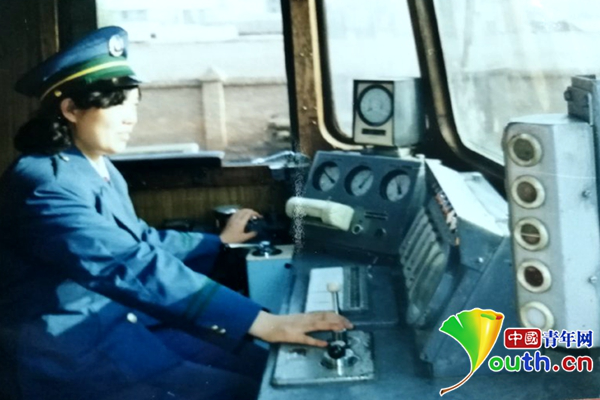
Yang Xianmei on an electric locomotive. [Youth.cn]
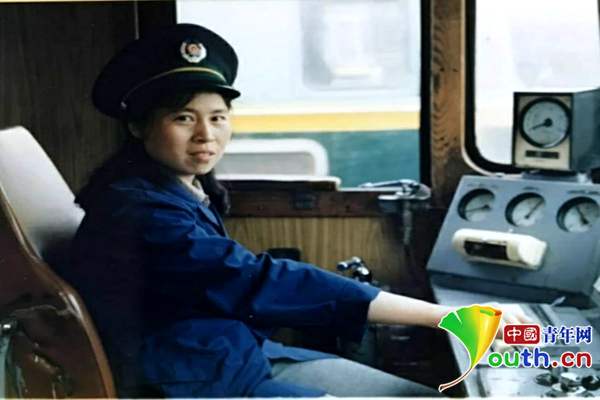
Hu Xuezheng interviewed on an electric locomotive. [Youth.cn]
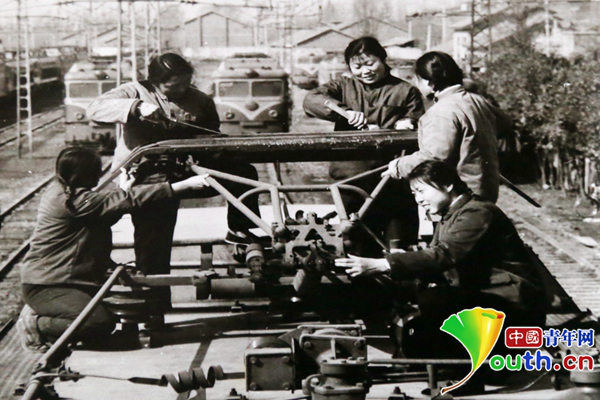
Female drivers participate in locomotive maintenance. [Youth.cn]

