High in a loft apartment in north Beijing, young people pass the time reading, talking and drinking coffee.
Welcome to the business model of China’s future – a heaven for the generation born in the 1980s and 1990s.
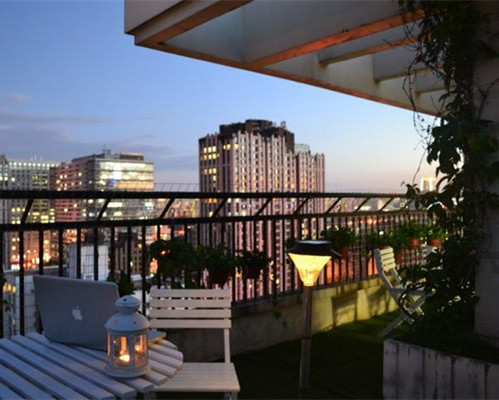
Nightview of 706's terrace.
“706 Youth Space” was founded in 2012 by 12 young men, six of them are students at different universities in Beijing.
The 300-square-meter loft in Huaqingjia Yuan housing estate, sits above the bustling Haidian District, home to many of Beijing’s 70 universities and hi-tech companies, where thousands of students and young talents want somewhere to hang out and find like minds.
706 is one of those places. It initiates events such as culture saloons, open classes, book sale and signing activities, movie showings, and “IT geek” seminars.
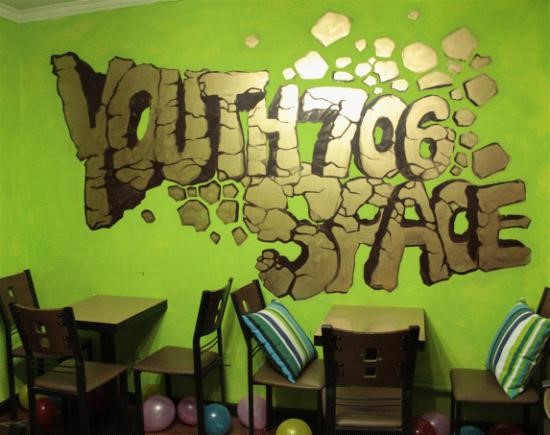
Logo of 706 on the wall.
Tsinghua University post-graduate student Cheng Baozhong, one of the founders, says: “Our motivation in founding 706 was to start a business rather than worry about our futures.”
Cheng, born in 1990, believes they should do something they like if they have no worries about basic needs and providing for their parents and grandparents.
A traditional enterprise focuses on making a profit, but 706, the first “youth space” in China, sees itself as a social enterprise.
The definition of social enterprise, according to the Social Enterprise Coalition (UK), is the use of commercial means to achieve a social purpose.
Harbor of the Soul
706 operates in an unconventional way, opening to young people to express themselves and decide what kind of activities they want. This benefits both guests, who enjoy the ambience, and staff, who focus on implementation without the burden of decision-making.
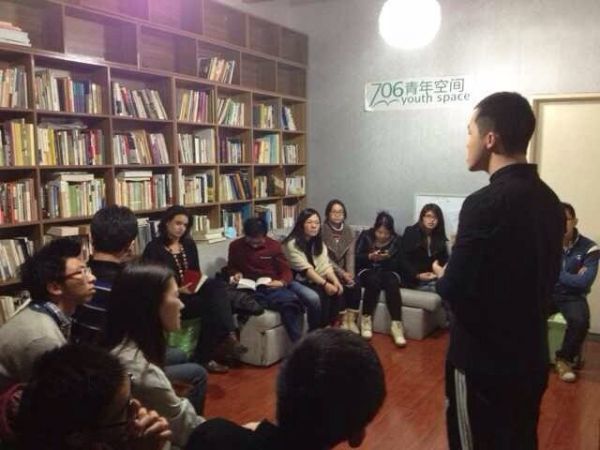
"The 3 minutes events".
Of the 15 to 20 events organized each week, 706 hosts up to five while the rest are hosted by other individuals or organizations.
It has held more than 500 events and is now one of China’s top youth event caterers.
Unlike the guidance provided by traditional education institutions, 706 encourages communication among youth to help explore their inner selves.
“706 will not tell you what is correct. Different ideas, stories and values here can lead people to reconsider themselves and find new possibilities. We hope 706 can be the harbor of the soul,” says Cao Yuteng, 706 public relations director.
Culture Mall
But business is still at the heart of this social enterprise, and 706 categorizes itself as a youth culture center with a coffee bar and library, and revenue sources include its hotel, which has 50 beds, events commissions, membership fees and donations.
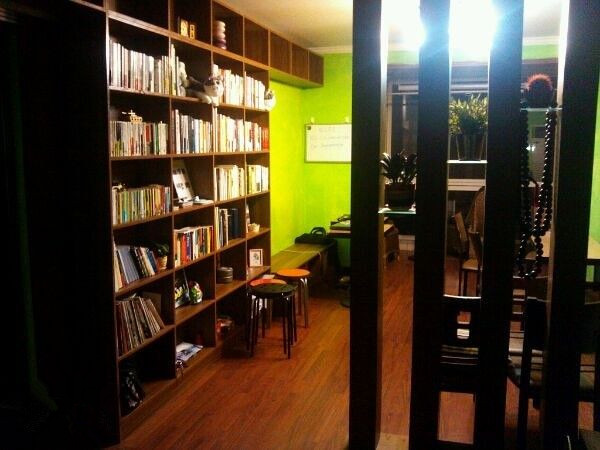
Library of 706.
“706 needs more than 200,000 RMB annually to keep operating,” says Wu Fangrong, one of founders.
“The earnings of 706 are mainly from two parts. One is from the accommodation, activities, membership fees and short summer camps. The other is from contributions and sponsors.”
Recently, 706 held an excursion to “return to nature” in Qiannan Buyi and Miao Autonomous Prefecture in southeast China’s Guizhou Province. It was sponsored by the prefecture’s local Communist Youth League Committee.
“All of the remaining money will go into the 706 public welfare fund, which is used to initiate projects such as social surveys and other public activities,” says Cheng Baozhong.
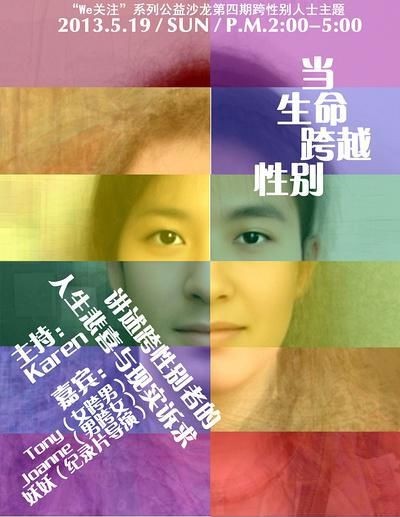
"We foucus" event poster.
706 aims to set up a national network and a platform to enable members to communicate more easily and find a sense of community.
Cheng says its future is as a “culture mall” that pays more attention to the experiences and communication needs of customers than the traditional culture industry.
Traditional business models, such as bookstores, are under growing pressure from online retailers.
However, 706 looks to other models like Taiwan’s Eslite Bookstore chain, which has pioneered a new business mode, selling books and related merchandise such as music, coffee, wines and tea, and serving as a creative hub.
706 has a flat – not traditional hierarchical – management that can solve the issues of agency overlap, low efficiency and redundant construction.
“This style of management depends on the personalities of 706,” says Cheng Baozhong. “Young people enjoy the freedom to communicate easily and this enhances the efficiency.”
“Our management mode is the essence of 706,” says Wu. “Everyone here takes part in decision making."
New Concepts
706 is now the biggest youth space in China and its members see real benefits.
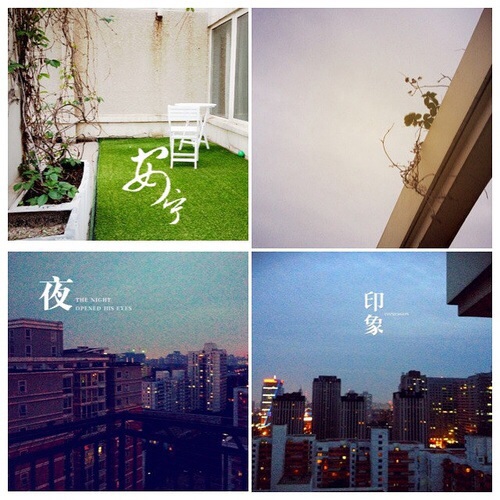
Views of 706.
“I have learnt too much in one area,” says Feng Yue, who is doing a doctorate in theoretical physics at Princeton University. “It narrows my view and I want to see something different.”
He thinks “706” reveals his true self by giving him a chance to express himself, share ideas and inspire others.
“706 brings new concepts and enlarges their spiritual world,” says Yang Xiu, teacher at Harbin Engineering University.
Cheng Baozhong and Wu Fangrong consider 706 as their career, and it has inspired a new era of youth interaction in China’s cities.

