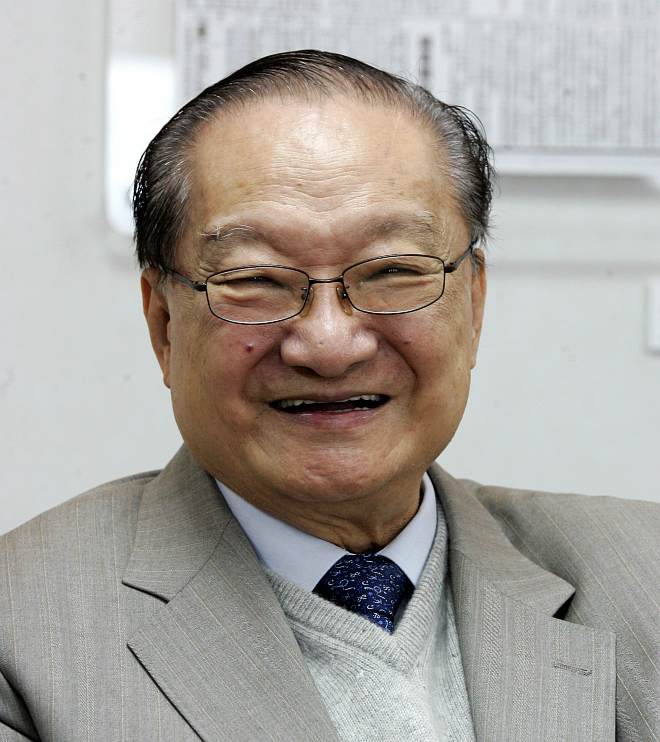
File photo of famous Chinese martial arts novelist Louis Cha Leung-yung, more widely known by his pen name Jin Yong. Cha created many widespread martial arts novels between 1955 and 1972. Cha, who also co-founded the Hong Kong daily newspaper Ming Pao, has been regarded as one of the greatest and most popular martial arts writers. Photo released by Xinhua
Farewell swordsman: Readers saddened by death of Chinese martial arts novelist Jin Yong
What are martial arts and swordsmen like? To most Chinese, the answer is to be found in the works of the late novelist Jin Yong.
Jin, whose real name was Zha Liangyong (also known as Louis Cha), died on Tuesday (Oct. 30) evening in Hong Kong, aged 94. The news soon went viral on the Chinese mainland, where he inspired a generation, ushering them into the world of Wuxia (swordsmen).
Wang Xiaolei, better known by his nickname Liushenleilei, has an official WeChat account with more than 100,000 followers. His articles are about Jin Yong's novels.
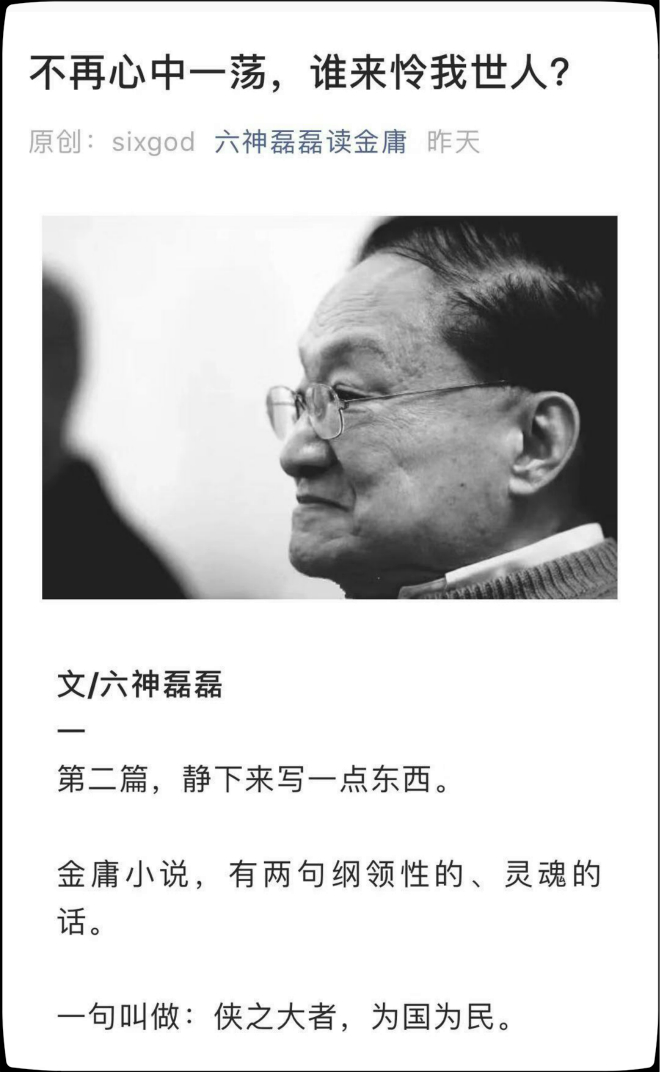
Screenshot from Wang Xiaolei's WeChat account.
"I began reading Jin's novels when I was in middle school," he told Xinhua. "At that time reading books like those were forbidden by parents and teachers, who feared that would distract us from study at school."
"While learning about the death of Mr. Jin I was having supper," he said. "I suddenly felt at a loss. I later sat in the toilet for quiet a while to calm down."
Early on Wednesday morning, he released an article mourning Jin. "I have no chance to meet you. You even didn't know the existence of my official WeChat account," Wang wrote. "Should I meet you, I would have asked you if you liked my article and if I could be considered your disciple?"
"I am only one of the tens of thousands of Jin's readers. He was liked by so many people. I never feel alone."
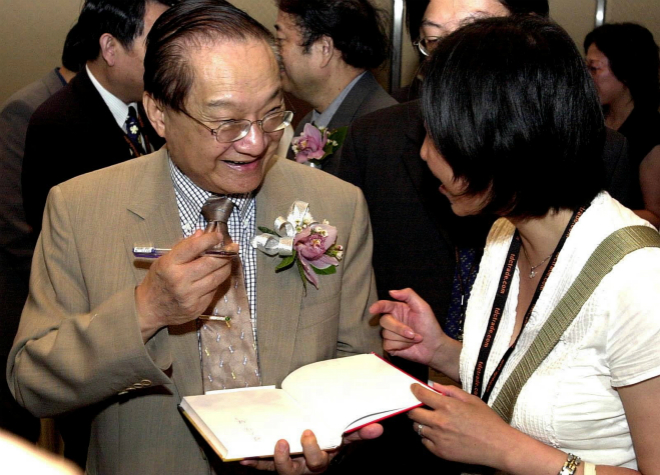
File photo taken on July 22, 2001 shows Jin Yong (left) signing a book for a reader during Hong Kong Book Fair in Hong Kong, south China. Photo by Shen Qiao
Wang said he believed the reason why Jin had so many fans was that Chinese people had a deeply-rooted admiration for chivalry and love for the country. "So the swordsmen under Jin's pens were their idols."
He noted that Jin had vast knowledge of Chinese traditional culture, as shown across his books.
In terms of writing technique, Jin borrowed from Western plays. "Some of his plots were just like ancient Greek tragedy," he said. "For instance, in his 'Demi-Gods and Semi-Devils (天龍八部),' the hero was like a tragic figure in Greek mythology."
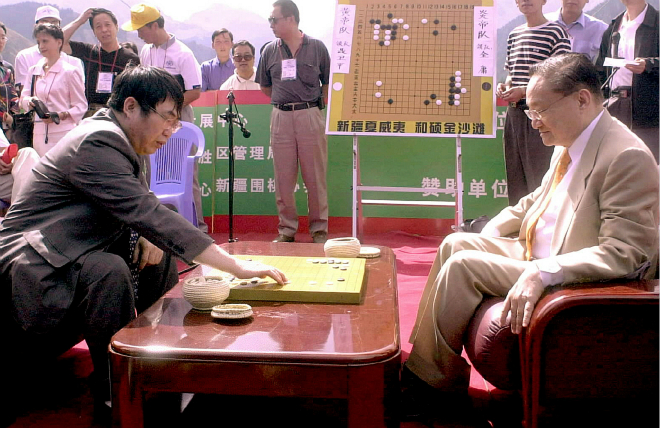
File photo taken on Aug. 5, 2001 shows Jin Yong (right of front row) playing against Chinese go chess master Nie Weiping, northwest China's Xinjiang Uygur Autonomous Region, on Aug. 5, 2001. Photo by Luo Xiaoguang
Zhang Fang also has an official WeChat account about history and Chinese literature. On Wednesday he released a prose written in the classical literary style in memory of the novelist.
"When I was a child, I watched TV dramas without knowing they were adapted from his books," he said. "When I entered primary school, I began reading his novels, only to find them so intriguing."
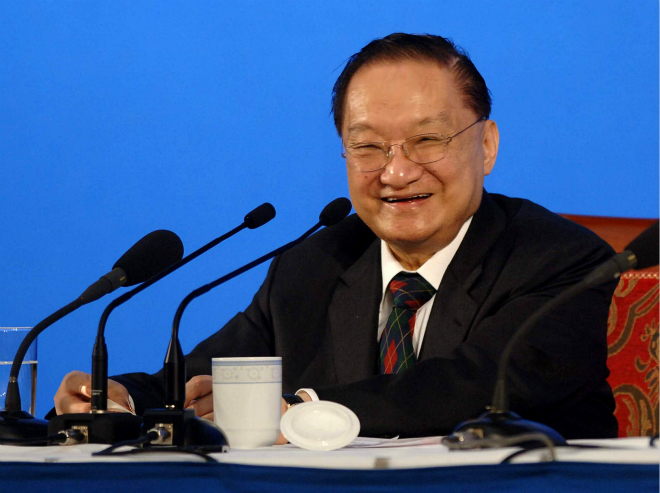
File photo taken on June 18, 2007 shows Jin Yong giving a speech at Peking University in Beijing, capital of China. Photo by Luo Xiaoguang
To some extent, his parents fell in love because of Jin Yong. "They were watching a movie adapted from Jin's novel in the cinema when they met each other," Zhang said.
While learning about Jin's death, he was reading the writer's book. "In his book you can learn about Chinese calligraphy, painting, music, medicine and wine," he said. "He was the most successful writer in popularizing traditional Chinese culture."
Zhang noted that when their generation began reading Jin's books, they were at an age when the their sense of value was just taking shape. "After I grew up, I found that my personality was so affected by the heroes in his books," he said.
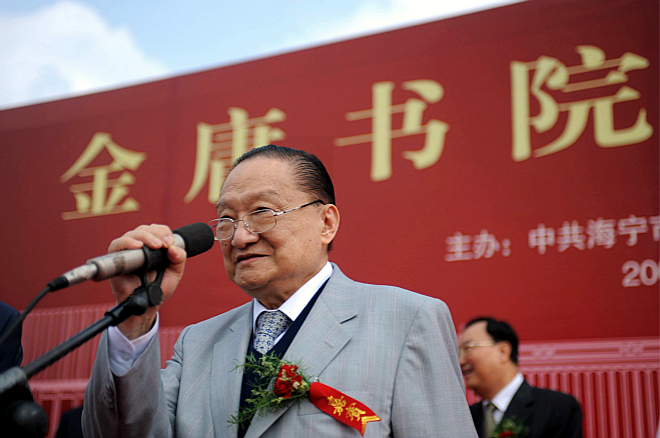
File photo taken on on Sept. 17, 2008 shows Jin Yong addressing the groundbreaking ceremony of an academy named after him in Haining, east China's Zhejiang Province. Photo by Xu Yu
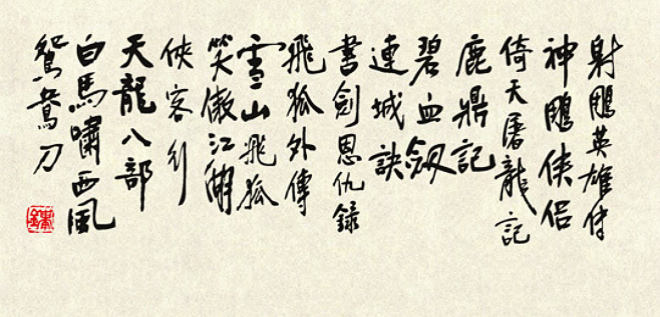
Jin Yong's calligraphy gives a presentation of his major martial arts novels.
Meng Yuan, who was supposed to work overtime in her company, felt too sad to continue when hearing about Jin's passing.
"He took me into such a wonderland," she said. When she was in middle school, she used to make up similar swordsman stories with her friends, some of which she still remembers.
"Writers in the West created new worlds like the one in the Lord of the Rings or Harry Potter," she continued. "If there is an imagined world in China, that is the world with martial arts and swordsmen Jin penned for us."
People living as far afield as Australia mourned for Jin on Wednesday (Oct. 31).
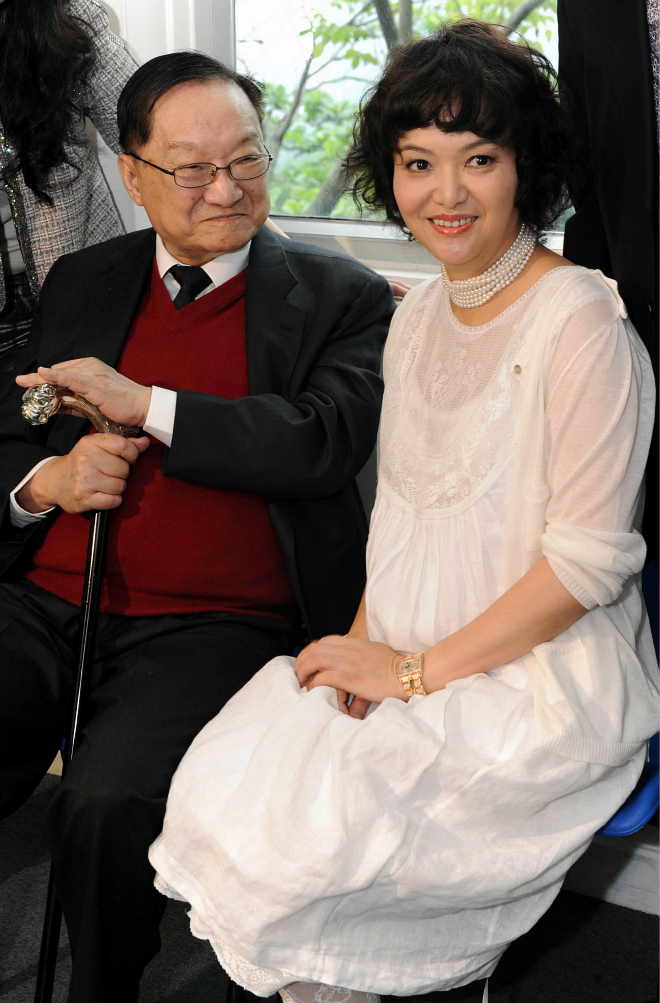
File photo taken on May 15, 2011 shows Jin Yong (left) attending an art exhibition of his daughter in Hong Kong, south China. Photo by Song Zhenping
Ouyang Dipin, manager of the Asia Collections in the National Library of Australia, told Xinhua that they had a collection of 28 books by Jin Yong, and were preparing an exhibition.
Ouyang arrived in Australia 23 years ago, but the move didn't prevent her from reading Jin's books. "He had such excellent depiction of humanity and human emotions," she said. "In Australia I know there are scholars studying his works."
Fan Shengyu, a senior lecturer with the Australian National University, said that Jin's influence knew no national boundary. "No matter in New York, Singapore or Vancouver, where there are Chinese, there are his readers," he said. "His death marks the end of an era for martial arts novels. We can hardly expect to see other writers with such influence and artistic achievement as him."

