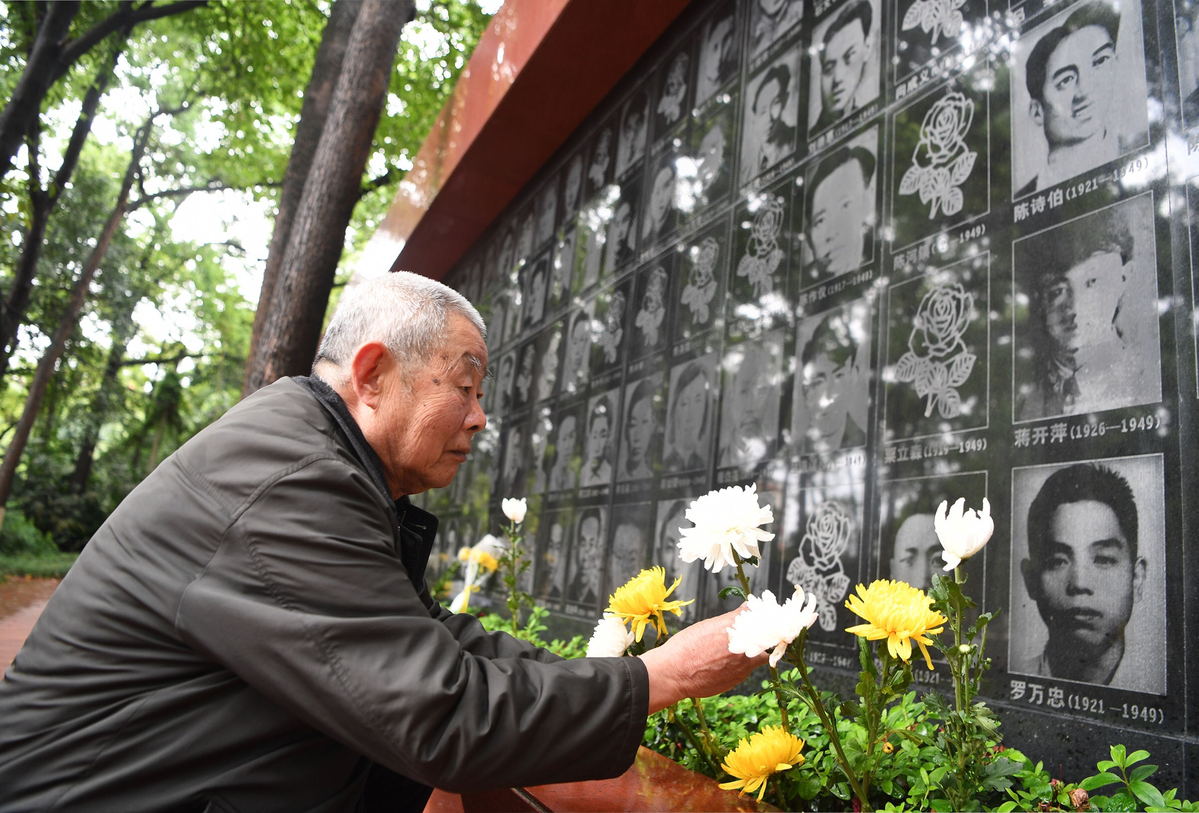
An elderly man offers flowers at the Chongqing Martyrs' Cemetery in Gele Mountain
on April 6, 2018. [Photo/Xinhua]
Core values of traditional Chinese festivals like benevolence, harmony and filial piety continue to find a place in festivals like Tomb Sweeping Day.
Zheng Fanying, 46, often sends messages about her recent activities to her late father on popular instant-messaging app WeChat, and also on special occasions such as his birthday and Tomb Sweeping Day.
Also called the Pure Brightness Festival, Tomb Sweeping Day falls on Friday this year, when Chinese will offer sacrifices and pay respects to the deceased at tombs. It is also a tradition when one lets off firecrackers, burns incense and paper money, and make offerings like flowers and fruits to the ancestors.
When Zheng's father passed away from cancer in 2015, it took her three years to move on from the inner pain. She wrote an article in his memory for an online cancer forum, with details about how he was diagnosed and treated. It became immensely popular and evoked empathy from the family members of cancer patients.
"There are various ways to commemorate the deceased in modern society. You just have to select the way that suits you best, just like my article," says Zheng, a Beijing-based editor.
"People live on as long as we remember them, which is also the best way to honor them. Just like Pixar's animation hit Coco, those from the Land of the Dead continue to exist as long as they are still remembered by someone on Earth."
Besides "chatting" with her late father on WeChat, Zheng has also uploaded a digital photo album of him at her home so that she can see him always.
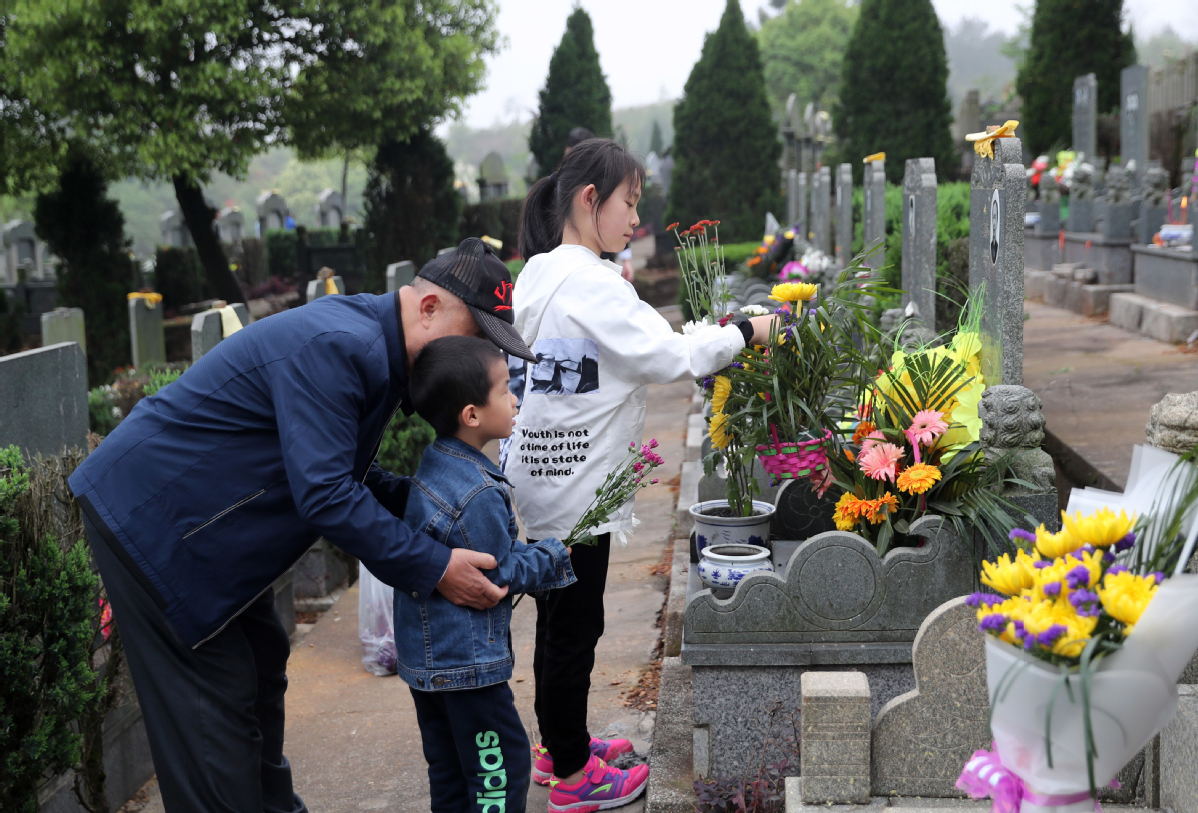
People make offerings of flowers at a cemetery in the Dongxiang district of Fuzhou, Jiangxi province, on last year's Tomb Sweeping Day. [HE JIANGHUA / FOR CHINA DAILY]
"I feel comforted greatly by doing so. It is as if my father is still with me. When I burn paper money for him, it upsets me a bit as it reminds me that he has passed away."
But that does not stop her from joining the traditional grave-sweeping activity with her family, as it gives her an opportunity to read epitaphs on other gravestones and understand the people who are remembered by their dear ones.
"I cannot but choke back tears when people pass away at young ages. When death comes calling everything is over. It makes me want to live in the present and cherish my life more."
Some Chinese people have gone one step further by establishing an online memorial site for their deceased relatives, through which they can offer virtual sacrifices like flowers and candles and post articles.
"I think it's a good alternative. It is convenient to hold memorial ceremonies online and people can express their sorrow and grief when they want," she says.
While some Chinese people are open to new options, there are still many who prefer the actual on-site tomb-sweeping experiences.
Jiang Yuchun used to visit tombs of famous people and revolutionary martyrs on Tomb Sweeping Festival. This year, he plans to join a traditional temple fair at Yixian county, Hebei province, to understand the local folk culture.
In 2018, he joined a small tomb-sweeping activity of John Rabe and Robert de Besange in Berlin, with over 20 local Chinese people. During the War of Resistance Against Japanese Aggression (1931-45), they offered numerous Chinese refugees food and shelter in Nanjing and Shanghai. Jiang is the initiator of the rebuilding of their tombs and monuments. He believes it's important to publicize their great contribution to the Chinese people and says it is good to pay homage during the festival.
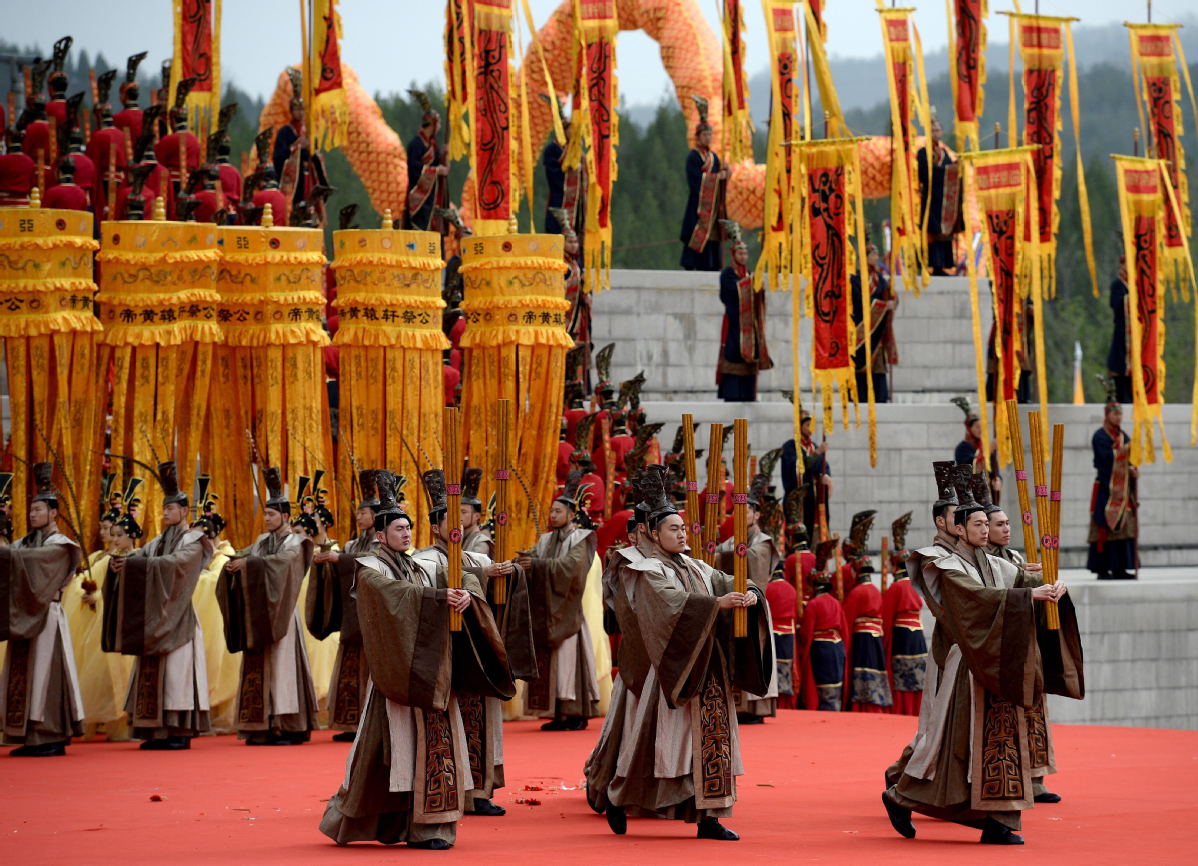
Performers present memorial rituals at the Mausoleum of Huangdi in Huangling county, Shaanxi province, on Tomb Sweeping Day on April 5 last year. [Photo/Xinhua]
For Xu Ran, 31, an office worker from Shanghai, Tomb Sweeping Day holidays are opportunities for a family reunion in her Anhui province hometown.
"Hiking on a spring day is also a tradition of the festival. We climb a hill covered with green bamboos to pay tribute to the tombs. After that, we dig edible wild herbs and tender bamboo shoots, both of which make delicious seasonal dishes," she says.
Chen Xiao, 31, from Beijing, couldn't agree more. For her, it's like an excursion for the big family as tombs are always on mountains.
"It's an important festival as it's connected with the deceased relatives. I ponder over sincere questions like the significance of life when I visit the tombs of my grandparents," Chen says.
"My parents talk loudly with the deceased and ask them to 'eat' the offerings — things that they liked when they were alive. It is a moment when I feel touched and try my best not to shed tears."
For over two decades, Wang Haopeng, 47, pays homage at graves of his grandparents at important festivals such as Lunar New Year's Eve and Tomb Sweeping Day.
"For me, it's more like a cultural inheritance and passing on of traditional filial piety. Since my son turned three, I have started taking him to the memorial ceremonies," says Wang, a photographer from Xi'an, Shaanxi province.
He believes the core values of traditional Chinese festivals are benevolence, harmony and filial piety, which symbolize the essence of Confucianism. For example, it is the custom to celebrate traditional festivals with families and this he says is a kind of harmony.
"It's important to be dutiful sons and daughters. Some Chinese couples care about their children more than their parents, whereas it is the latter that need more attention. It will be pitiful when you want to fulfill your duty but your parents have already passed away," he says.
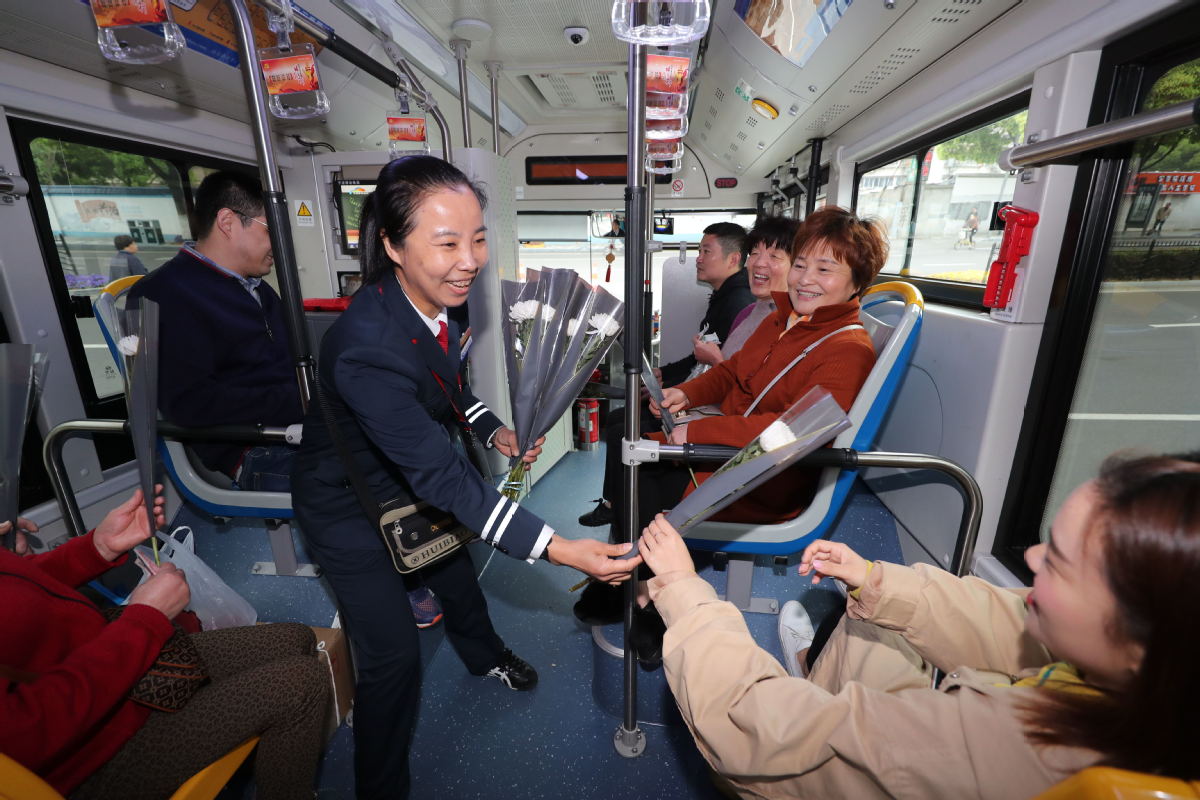
A conductor gives out chrysanthemums on a special bus service for tomb sweeping on April 5 last year in Ningbo, Zhejiang province. [ZHANG PEIJIAN / FOR CHINA DAILY]
In recent years, however, he has to do the family routine at least one week ahead of Tomb Sweeping Day.
As a photographer, he joins the annual ceremony paying homage to Huangdi, or the Yellow Emperor, who is regarded as one of the common ancestors for all Chinese. It's held by the local government on Tomb Sweeping Day at the Mausoleum of Huangdi in Huangling county, Shaanxi province.
Chinese people often call themselves the descendants of the Yan and Huang emperors. It's believed that the Yellow Emperor defeated other tribal leaders, the Yan Emperor and Chiyou, unifying all tribes in ancient China around 4,700 years ago.
In Huangling county, many Chinese from home and abroad join the ceremony to show their respect, which includes traditional singing, dancing and orations.
After the ceremony, they're allowed to take the sacrifices as a symbol of good fortune, including mianhua, a local steamed bun made of wheat flour in various shapes like animals.
"The Yellow Emperor is the spiritual icon of Chinese people, and such ceremonies can bind us together. Also, young Chinese are involved as volunteers and performers, and they can learn more about the tradition," Wang says.
He says that unlike the past, the ceremony has been attracting more Chinese than before. Meanwhile, the Mausoleum of Huangdi has also improved its infrastructure to cater to the growing demands of tourists.
"Tomb Sweeping Festival is more like an identification of the Chinese culture. With China holding more public memorial services for martyrs in recent years, it has also become an important way to instill patriotism," says Guo Wenbin, a well-known author.
Guo has written a popular short story about Tomb Sweeping Day, which is based on his childhood memories in his hometown, a small county in Ningxia province.
"Chinese believe that humans are an integral part of nature. As Tomb Sweeping Day approaches in the spring, the spirituality of humans has a better corresponding relationship with that of the universe," he says.
He adds that in the traditional Chinese values, the best way to honor one's ancestors is to bring glory to them, such as getting ahead in one's career.
According to him, when young Chinese get back to their roots to join tomb-sweeping activities of the family, they get a sense of belonging and security, and it will help ease their life anxieties.
"If you compare traditional culture to a textbook, traditional festivals are like the classrooms. Without a classroom, there will be no more textbooks.
"It's just like cooking rice. While the ancient people used primitive stoves, we use electric rice cookers. No matter how the method changes, humans need food to survive. So do festivals, which are necessary for our social and psychological demands."
He admits that traditional festivals have changed with times and been influenced by commercialization.
"But it's important that people are aware of the significance of these festivals. Some entrepreneurs are also advocates of traditional festivals. As more Chinese are seeking spiritual life for a sense of belonging, these festivals will continue be a vital part of our life."

