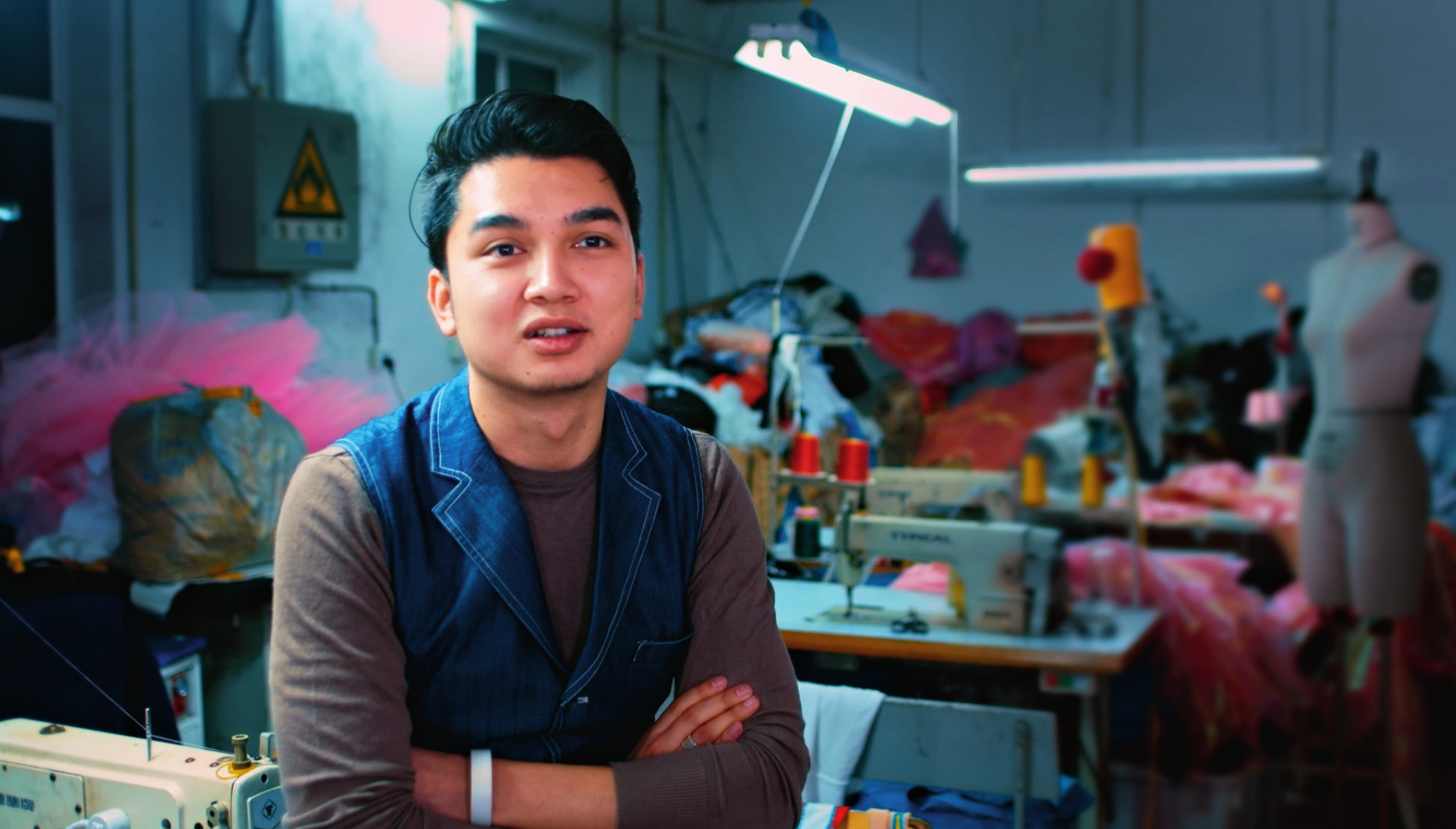
Alimjan Adili: The starting points of many of my inspirations are Xinjiang’s ethnic and cultural elements. My heart will be thrilled and filled with deference the moment I see uniquely excellent renditions of cultural profundity.
I started selling t-shirts when I was a freshman of fashion design at Beijing Institute of Fashion Technology. By the third year in college, after gaining some sales experience and developing some design concepts, I began consciously to design and manufacture my own fashion products and brands.
I used to think my rich experience would get me to a good start in society, but it turned out things did not come my way as I went about implementing certain plans.
Upon graduation, I decided to set up a fashion studio back in my hometown instead of seeking a steady job. At the start, instead of actively hunting for a proper rental property for use as business premises, I unrealistically thought a certain friend in my social circle would be willing to provide that for free. But it turned out there was no such thing as a free lunch. After I had wasted two months, my dad let me take over an apartment owned by the family and use it as my office.
Another person who has helped me in a great way was an art director of the 13th National Winter Games, whom I had met at an arts and crafts exhibition. With her recommendation, I was appointed special fashion designer for the said Winter Games. It was the kind of opportunity every recent college graduate would covet.
So, apart from working on the studio, I devoted myself whole-heartedly to fashion design for the Winter Games. It was a big test for me, because I didn’t have much experience and I had to take care of all of the details, including design making and communicating with models and sponsoring businesses. During the process, I discovered many of my weaknesses and knew I had overestimated myself clearly. I needed to know myself better in order to stay steady in every step I took. After going through all these, I finally established my company and I named it “Scholar,” which is the literal meaning of my Chinese name and a true representation of my past and present. I am always learning and I want to keep learning in the future.
My initial line of business was custom-made clothing, but later I started creating my own brands to sell, thereby getting across the cultural images of our ethnicity to the general public. My mission statement is to let culture permeate everyone’s life, which may take years to accomplish. I will have to take it one step at a time.
In fact, before age 23 I had no clue what Xinjiang would give me. When I was 24, I spent a lot of time and effort on my graduation project. I used six pieces of clothing to illustrate my perception and passionate love of Xinjiang. I summarize it as a “root seeking journey.” My current focus is to market my brands and demonstrate the glamor of my ethnic culture through fashion so that everyone can have a better understanding of Xinjiang through such aesthetic elements.
Years ago, when I visited the old urban area of Kashgar, I was suddenly seized with creeps all over me and I had a feeling that made me want to cry. I could never see why, nor could I accurately describe what that feeling was. As I started digging for the rationale, I came to realize the starting points of my inspiration are Xinjiang’s ethnic and cultural elements, which stimulate new ideas in me and motivate me to do new things. When I asked my graduate project supervisor why I would react to such elements so passionately, he gave me a terse answer:
"Because your root is in Xinjiang!"
(selected from Xinjiang: Beyond Race, Religion, and Place of Origin by Kurbanjan Samat, translated by Wang Chiying, published by New World Press in 2017)