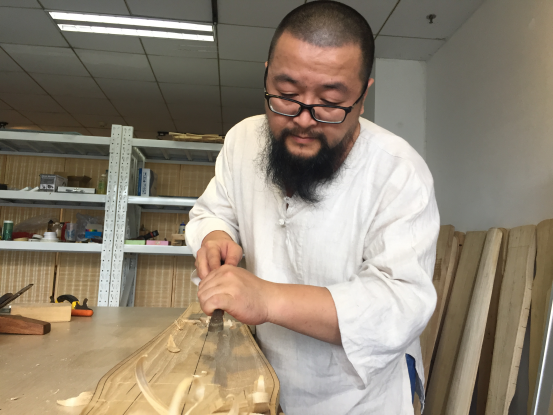
Wang Bing hones wood by hand with a chisel during the process of making the body of a guqin. [Photo by Zhou Xumin/For chinadaily.com.cn]
At a young age, under the guidance of his grandfather, Wang Bing began learning how to make the classic seven-string Chinese musical instrument called the guqin. Now, at age 43, he has mastered the craft and will pass it to future generations.
Revered among the four major Chinese classical arts — alongside chess, calligraphy and painting — the guqin reaches back in history more than 3,000 years. It has been favored by scholars and literary figures and is widely known as the great ancestor of Chinese music.
In 2003, the art of guqin — both the music and the culture — was included in UNESCO's intangible cultural heritage list.
"It takes about two years to fabricate a collectable guqin," Wang said. "More than 100 complicated procedures are required to complete one, from selection of material to the making of billets, tuning and gray coating.
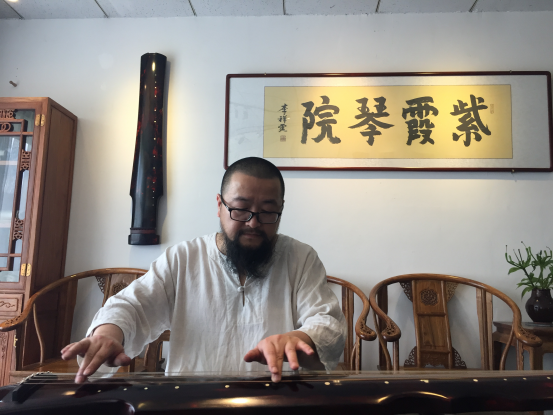
Wang Bing tunes a finished guqin. [Photo by Zhou Xumin/For chinadaily.com.cn]
Wang, who lives in the Huichuan district of Zunyi, Guizhou province, began his journey to guqin mastery at age 12, under the tutelage of his grandfather, a master craftsman. His favorite pastime as a boy was watching the older gentleman work with wood, and he treasured the instructions, explanations and wisdom.
Since 2008, he has been making instruments full-time. Wang can produce five to 10 collectable guqin to sell in a year. The handmade instruments have been sold in America and Canada at prices that can reach hundreds of thousands of yuan.
Located within Xinpu Wetland Park in Zunyi, the workshop appeals to crowds of guqin lovers, who visit and learn.
Meanwhile, Wang's wife, who graduated from the Central Conservatory of Music, is offering courses in playing the guqin both in the workshop and at the Zunyi library.
Making guqin is an ancestral craft in Wang's family. As his progenitors did, he often works alone in his workshop. He uses hand tools, a small router and a band saw to refine each delicate instrument.
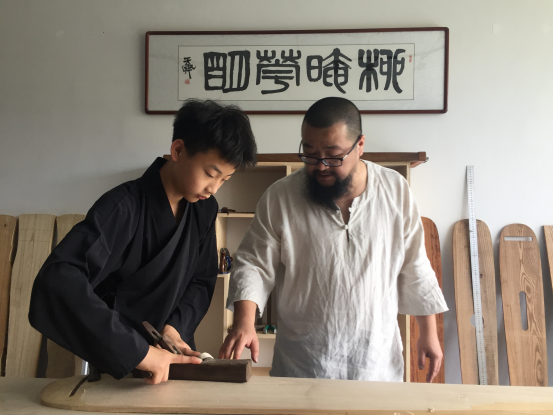
Wang Bing teaches his son the craft of guqin making. [Photo by Zhou Xumin/For chinadaily.com.cn]
Wang said he makes guqin of two types: one for collection, the other for student practice. The most valuable ones of superior quality come exclusively from his own hands.
Last year, Wang was recognized as a provincial-level inheritor for promoting guqin culture. The best way to fulfill that mission is to teach, he said, noting his plans to transform the workshop into a multifunctional art center dedicated to the guqin. Various courses in Chinese arts will be offered to attract practitioners.
Nowadays, Wang and his wife carry forward the traditional culture through manufacturing, teaching and promotional efforts. More than 100 students have been enrolled for study in their music studio. Their son began learning to play the guqin at age 5. They hope he will master the instrument and enter a musical college in the future.
One of the trainees, Wang Jixia, has studied the guqin for four years at the studio and has completed the first stage of teacher training. Wang also plans to teach his son the fine points of making this remarkable musical instrument and hopes the training will be complete by the time the young man is in his 20s.
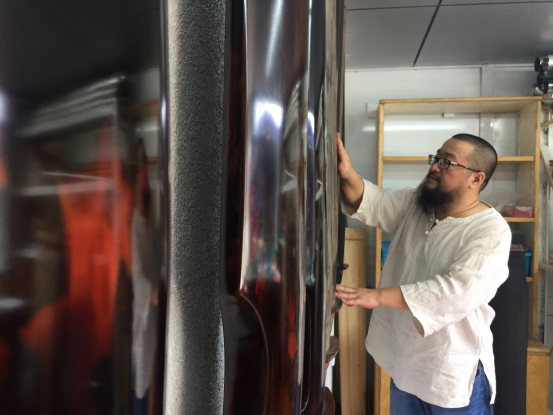
Wang Bing places partially finished guqin pieces along the wall to dry. [Photo by Zhou Xumin/For chinadaily.com.cn]
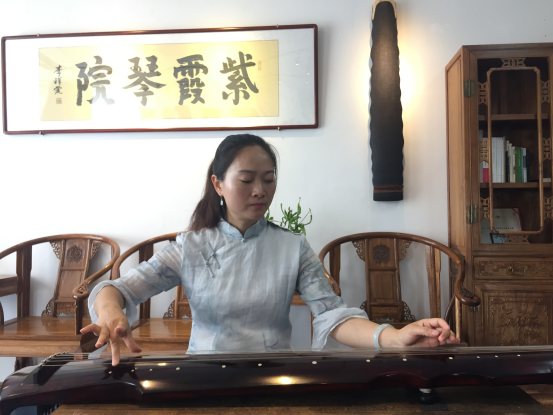
Student Wang Jixia often practices guqin in Wang Bing's studio. [Photo by Zhou Xumin/For chinadaily.com.cn]

