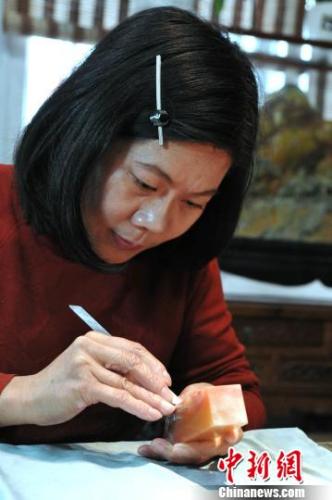
Ye Zi, a Shoushan stone sculptor in East China's Fujian province, works on a stone carving. [Photo/Chinanews.com]
Among the 130-odd types of Shoushan stones mined in Shoushan village, East China's Fujian province, Huakeng stone is a more readily available and less precious type compared with other rare ones.
However, Ye Zi, a female Shoushan stone sculptor, has been working to infuse the plain-looking Huakeng stone with traditional Chinese culture and turn it into works of art with a different kind of aesthetic value.
Interestingly, unlike many other carvers, Ye didn't learn sculpting skills from a certain teacher, but from books. For this reason, she could avoid the influences of a teacher. Therefore, during her past 20 years in this profession, she has been trying to find the merits in every type of Shoushan stone, instead of only being attracted to those more precious varieties.
Mottled in color and rough in texture, Huakeng stones are normally less adored by Shoushan stone carvers. Nevertheless, Ye has noticed a special beauty in them. She thinks they are "simple" and "pure", like the scholars in ancient times -- plain on the outside, yet charming within.
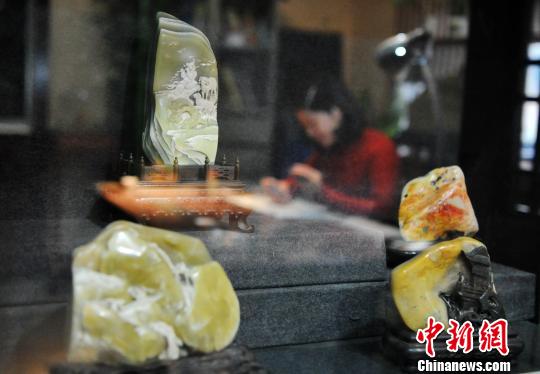
A selection of Shoushan stone artworks created by Ye Zi, a Shoushan stone sculptor in East China's Fujian province. [Photo/Chinanews.com]
Ye is from Pucheng county, the northern tip of Fujian province, which is also the hometown of Liu Yong, a renowned poet during the Northern Song Dynasty (960-1127). Human figures, flowers and fruits, and animals have long been the main themes of Shoushan stone carving. But Ye has focused more on portraying Chinese classical landscapes and idyllic scenes from her hometown.
Concerning the sculpting techniques, Ye said that sculptors need to "draw on the traditional and innovate the new". Traditional Shoushan stone carving techniques must be well-learned and properly combined with Western sculpting skills so as to give full play to the original beauty of the stones.
One of Ye's representative artworks is carved from a Shanxiuyuan stone, also an unpopular type of Shoushan stone. This carving, inspired by ancient Chinese poetry, has won the hearts of many viewers at exhibitions held at home and abroad. With pine trees, banana leaves and plum blossoms, it features a series of scenes depicted in ancient poems, including maidens reading by the window and scholars playing guqin, a seven-stringed zither, and the bamboo flute.
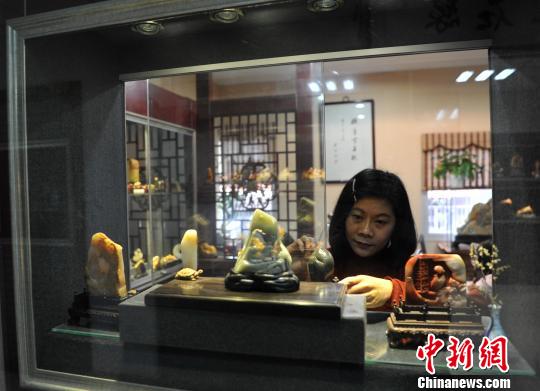
Completely awed by the artistic beauty of the work, viewers pay little attention to the value of the stone itself. A critic said when he was appreciating the art piece, he felt that "a shaft of moonlight seemed to filter through the artwork." A musician from Shanghai was even moved to tears when viewing it.
Currently, due to the increasingly reduced availability of prime Shoushan stones, many sculptors are turning to Laos stone, an alternative to Shoushan stone. Meanwhile, other carvers are trying to improve the value of common Shoushan stones by innovating sculpting techniques and design, according to several businesses in the Trade Center of Chinese Shoushan Stone.
"The focus of Shoushan stone carving is being gradually shifted away from the material to art. In recent years, instead of merely focusing on the choice of stone, Shoushan stone carving has become more concerned about styles and aesthetics. As a stone is only a carrier, it's more important for a sculptor to discover something new," said Ye.
Ye Shaobo, director of Fujian Arts Industry Association, also said local sculptors are paying more attention to the personality in their artworks while holding fast to the tradition of Shoushan stone carving. This artistic awakening will not only increase the added value of Shoushan stone carvings but also boost the influence of the whole industry.

