Staring at the frozen Ulungur Lake, Buzayinap Abulahat could not help asking questions with her eyes wide with curiosity.
"Is that an egret? Am I standing at the seaside?" The 23-year-old Uygur girl had never left her home county Moyu in Hotan Prefecture of northwest China's Xinjiang Uygur Autonomous Region, except once in 2008 when she accompanied her younger sister to Urumqi for cardiovascular surgery.
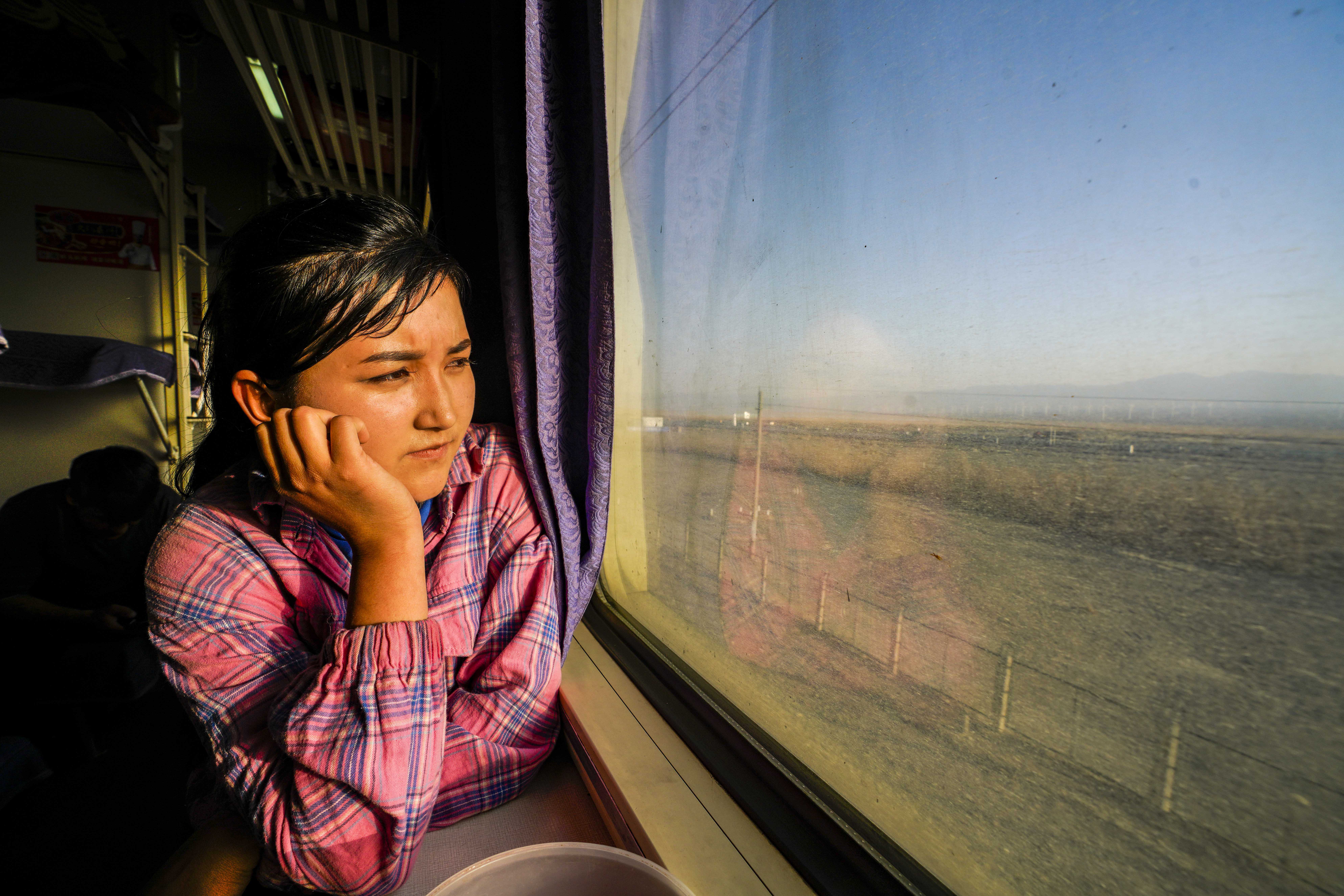
Buzeynep Abulehet looks out of the window on the train heading north to Fuhai County, northwest China's Xinjiang Uygur Autonomous Region, March 27, 2020. This year, Xinjiang has created 50,000 job vacancies in its eastern and northern parts for poverty-stricken households in Kashgar, Hotan and Kizilsu, in a bid to help 165,800 people from 10 poverty-stricken counties in southern Xinjiang to shake off poverty.(Xinhua/Zhao Ge)
Her family of six own less than one-seventh of a hectare of farmland in Moyu in southern Xinjiang where life is difficult due to the dry climate and weak industrial foundation.
Abulahat's father was born with a heart problem, so was her younger sister, who received free surgery in Urumqi supported by the local government but has to remain on medication.
To help her family loosen the grip of poverty, Abulahat hit the road without hesitation when she heard from others in late March that there were job opportunities in a northern town, leaving her home village on the fringe of the desert.
"I'm the firstborn, and I don't want to miss the chance to improve the lives of my family," she said.
Abulahat was favored by a local travel agency in Fuhai, a county at the foot of the Altay Mountains, some 2,720 km from Moyu, due to her Mandarin and computer skills.
As a major task of poverty relief work in Xinjiang, cross-regional employment plays an important role in helping impoverished households get rid of poverty, with 126,600 poor residents in the southern parts of the region supported through employment transfer since 2018.
The region plans to create 50,000 jobs in cities and towns with better conditions in the north and east this year.
"Now with the supportive migrant working policy, I will seize the job opportunity," Abulahat said.
Her mother Ayinusahan Hrudi just secured a public welfare position with a monthly pay of 2,000 yuan (about 283 U.S. dollars), which eased her worries of working far from home.
Abulahat took a northbound train with dozens of her fellow villagers, crossing the Tianshan Mountains. She appreciated the scenery along the way, singing ballads from home, smiling.
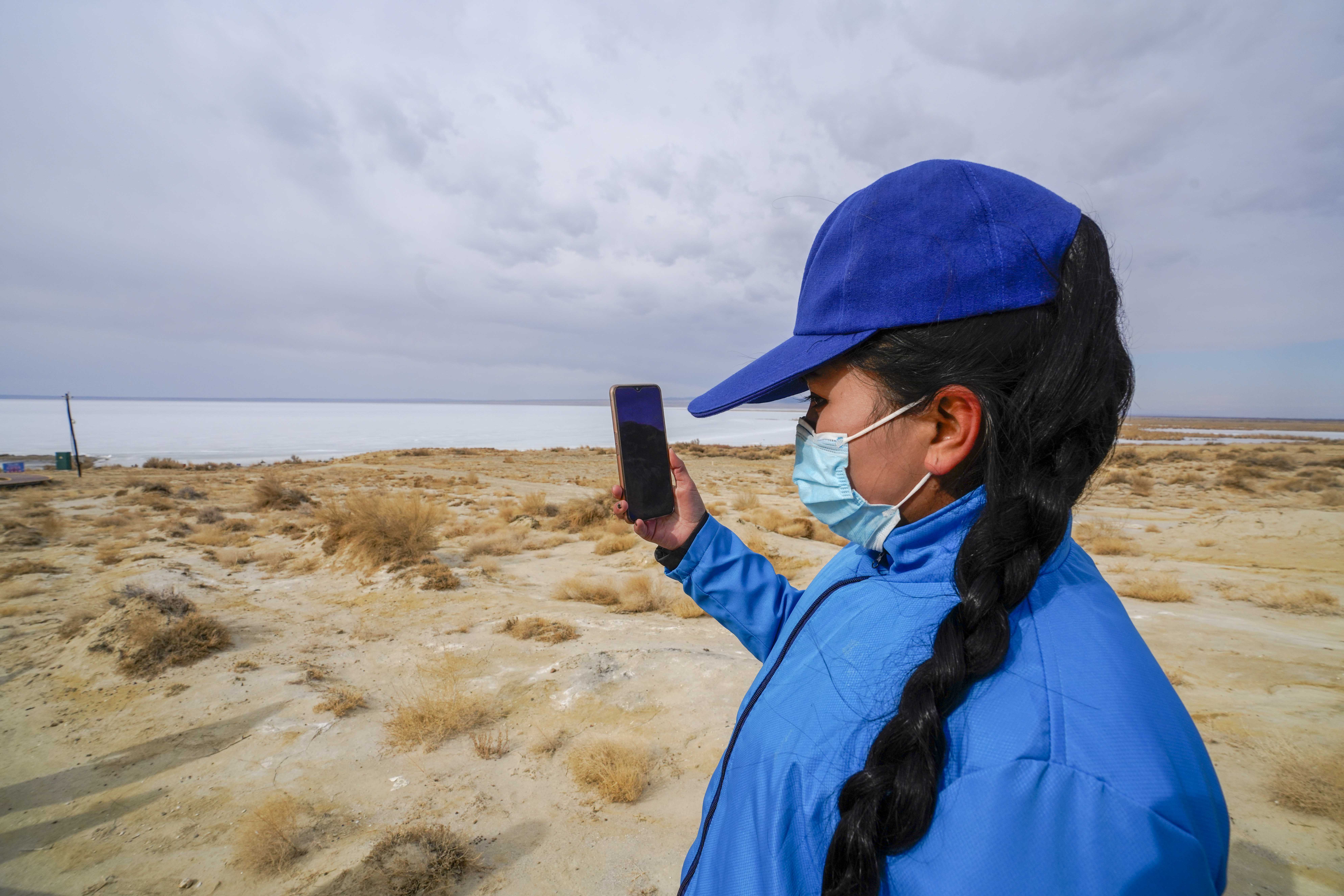
Buzeynep Abulehet takes photo as she sees the Ulungur lake for the first time in Fuhai County, northwest China's Xinjiang Uygur Autonomous Region, March 29, 2020. This year, Xinjiang has created 50,000 job vacancies in its eastern and northern parts for poverty-stricken households in Kashgar, Hotan and Kizilsu, in a bid to help 165,800 people from 10 poverty-stricken counties in southern Xinjiang to shake off poverty.(Xinhua/Zhao Ge)
With the help of the local management and service bureau for migrant workers from southern Xinjiang, Abulahat passed her job interview and will work at a scenic area in Fuhai with an iconic yardang landform, irregular ridges of compact sand eroded by the wind.
Her fellow villagers also met with employers in Fuhai. Some got jobs in local restaurants, some became cashiers, while those who like to work on the land went for field management on large-scale farms.
Multiple measures have been rolled out to help the migrant workers enjoy stable employment by matching their skills and capabilities with the demands of local enterprise employers, said Wang Lin, executive deputy head of the bureau.
Abulahat recalled her mother was a bit worried at first when she bid farewell to the family and told her mother that everything had been arranged.
"Mom then encouraged me to learn more and said that good days are coming soon," she said.

