From 1969 to 1975, Xi Jinping lived in Liangjiahe, a small village in China's Shaanxi Province as an "educated youth." In the village, Xi joined the Communist Party of China and was elected Party branch secretary. The following is an excerpt from LIANGJIAHE VILLAGE:A STORY OF CHINESE PRESIDENT XI JINPING, published by FOREIGN LANGUAGES PRESS in 2018.
Yan'an in those years was shackled by poverty. On June 9, 1973, Premier Zhou Enlai visited Yan'an with Vietnam's state and party leaders. According to Tu Jinzhang, the head of the Yan'an Prefectural Administration, Zhou Enlai had asked, "Why is it so bad?" - after learning that many people in the area went hungry and that one family of five had to share one bedcover. From the table full of fine food and wine, Premier Zhou only took one small bowl of millet. "I have not discharged my duty well enough, if the people here still live with the pain of poverty..." said Premier Zhou, eyes glistening with tears.
At that time Yan'an included 14 counties, 1.3 million residents, with a per-capita food ration of 250 kg per year and a per-capita annual income of 50 yuan. Their life could be described as, "no food in their pots and no money in their pockets."
Premier Zhou requested the Party Committee and Prefectual Administration of Yan'an, "to change the situation of Yan'an in three years and to double its crop yields in five." He said he would visit again when things got better in Yan'an.
Premier Zhou's request, widely publicized, was enthusiastically received by the local people. Many of the urban youth, already promoted as officials, requested to return to their rural placements to help increase food productivity.
At that time, Xi was already pondering and formulating strategies to enhance the crop yields of Liangjiahe.
After becoming the Party secretary of Liangjiahe, he proposed a project that surprised the villagers - construction of a silt dam.
The project involved the construction of two dams to contain and divert floodwaters in the valley, so that the floodwaters would carry the washed silt downstream to form a stretch of level silt lowland. It was a new idea and new technology for the village. According to Xi's plan, the level silt lowland would become new arable land to alleviate hunger in the village.
The exciting plan propelled Xi forward. He publicized the plan and endeavored, door to door, to persuade the villagers to pitch in.
Much controversy floated around: "Xi Jinping wants to give us a dam to increase our grains; it's a great idea. But the floodwaters are too ferocious; it will simply wash away the dams and all the invested effort. All will just be work in vain!"
The worries were not groundless. The outlet from the valley, during the rainy season, became a huge floodgate. Not enough vegetation existed to absorb the rainwater and prevent floods. No ordinary dam would be able to sustain the force of the silty floodwaters.
That's why villagers had once considered of building dams at gullies,
Their objection was not to the construction of silt dams, but to the proposal of the valley outlet as the construction site. No one had ever thought of building dams at the valley outlet.
Xi knew there was another reason, a tacit one, for their objections - families with the Wang surname, a total of 12 households, had their ancestral graveyards at the valley outlet.
Yet Xi proposed a plan that none had dared to consider before, a plan he was however ready to propel to fruition. He went to talk to Wang Xianping, who had been assigned to work at the Guanzhuang People's Commune. Xi said, "Heizi, you have been officiating weddings and funerals in our village. The whole village listens to you. Could you help me get this done?"
After hearing Xi's plan, Wang figured it all out. He knew the source of the resistance, and expressed his initial reservations: "I'm willing to help, but do you really believe it to be feasible? You know how ferocious the floods might get."
Xi said, "I've thought it all out long ago. We can block one side and buttress the other side of the valley outlet. We'll dredge and deepen the riverbed to drain the floodwaters more efficiently. So long as we can contain the floodwater at its summer peak, there won't be a problem. A solid high-quality construction will help extend our arable land all the way to the village."
Wang was all too familiar with the local topography, and he felt much more confident after heating Xi's explanations and strategies.
Xi said, "Think about it. Why are we poor and hungry? It's due to a lack of arable land. The silt dams will significantly expand our arable land, a legacy to bless all posterity! We must get it done, at all costs!"
"Let's do it! I'll talk to the villagers," agreed Wang. He then took leave from the commune and went back to the village to pitch the idea to all the generations of grandparents, parents and siblings named Wang.
Those at the age of his grandfather intoned, puffing on their pipes, "Heizi, that's the ancestral graveyard of the Wang family. The choice of the site was endorsed by a geomancer. No location better than that could be found. So, don't even think about it!"
Then the uncles chimed in: "We have no fear, but we challenge you to find another gravesite, as good and as nearby as the current one!"
His cousins mocked him: "If you're so generous, do whatever you like with the ancestral grave of your own family. Ours, just leave alone!"
No one budged at his first pitch, but Heizi wouldn't give up his efforts. Every single day for days on end he visited kinfolk, explaining to them Xi's plans, over and over again - how to channel the water, how to dredge the riverbed, how to buttress the dams... "Your worries have a basis. But safety won't be a problem, so long as the construction is solid."
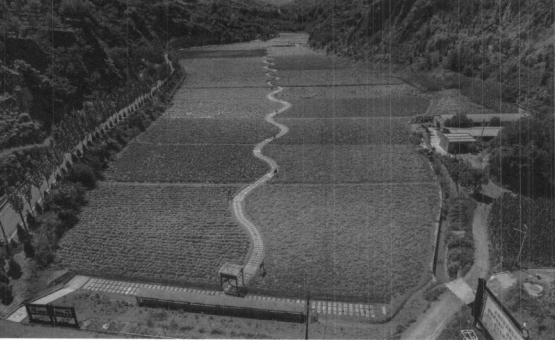
The silt lowlands
His tenacity eventually wore them down and some began to budge. Sensing an opportunity, Wang was ready to clinch the deal: "Look, Xi is a solid and reliable guy. When did you ever see him indulge in rash nonsense? Even as an outsider, he takes on all the burdens for us. He works the hardest, either as doer or as leader. After a hard day's work, he still does his own washing and cooking. Everything in the village demands his attention. What does he get out of this silt dam project? - nothing except more trouble! He's doing it for us, so our bellies could be better-fed. Wouldn't it be a great future when we grow more food than our bellies can take! You're the elder generation, held in esteem by villagers. The project won't succeed without your blessing."
Finally, the elders were persuaded. They said, "Jinping certainly is a solid guy and has our good in mind. He's been to school and has more knowledge than we do. We won't stand in his way anymore."
The decision was finalized and the case closed, despite some lingering opposition.
Thus began the first silt dam project at Liangjiahe, with much enthusiasm. Xi threw himself headlong into it, day and night, both as a worker and as the leader.
Quickly, however, a problem popped up. No one knew for sure how much force the dam had to sustain. So Xi invited engineers, from the county's Waterworks Department, to survey the terrain of the worksite, and to make calculations based on records of the locale's flood history. The new dam had to be able to hold up against floods of a century's records. With these necessary calculations, their construction then went ahead accordingly.
The most grueling work of the construction was clearing the silt at the outlet of the pump. Shi Chunyang affirmed this: "It was fast and hard work. The muddy water could smother you." But Jinping volunteered to work at the pump. In addition, he sought out the work of shoveling and ramming the soil, and transporting gravel. Under his initiative and leadership, the silt dam was successfully completed by the enthusiastic villagers.
To this day, that stretch of silt lowland remains the best and most level in the village, a rich and everlasting legacy bequeathed by Xi after becoming Party secretary of the village.
In his 2015 visit to Liangjiahe, Xi stood by the dam for a long time, by the poplar trees standing tall and strong on the silt lowland, resembling soldiers in array for his review.

