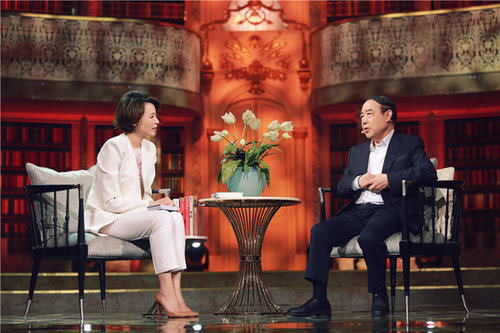
Dong Qing (left) interviews author Jia Pingwa in season two of China Central Television's literary talk show The Readers. [Photo provided to China Daily]
The slow pace and soft focus of a CCTV literary show seem to be appealing to viewers. Wang Kaihao reports.
Former NBA superstar Yao Ming is taking to a new kind of stage.
Unconventionally, the man, who is probably one of the best recognized Chinese athletes on the international arena, is showing people another side to his personality with The Readers, a TV program produced by China Central Television.
He is reading a Chinese translation of True Nobility, a work of prose written by American novelist Ernest Hemingway.
"To regret one's errors to the point of not repeating them is true repentance," he reads. "There is nothing noble in being superior to your fellow men. True nobility lies in being superior to your former self."
He explains the chapter is devoted to people who love sports.
The new show revolves around words, but it goes far beyond what is read.
Last year, the first series of The Readers broke the mold and taught Chinese TV audiences that a talk show does not have to simply be about amusement. Now, with its second series, the show returns with its trademark slow pace, warm touch and mesmerizing vocal rhythms set in an intimate atmosphere. The first episode of season two aired on Saturday and is set to run weekly.
In each episode, several guests-celebrities, famous scholars or ordinary people with touching personal stories-are invited to read aloud passages from their favorite literary works, which usually selected from classic poems or novels. This follows a short interview where the guests share meaningful moments from their lives.
For Yao, who is now head of the Chinese Basketball Association, his experience in conquering continuous injuries seems to echo with the concept of "true nobility" advocated by Hemingway.
Dong Qing, producer, director and anchor of the show explains that the aim of the program is to arouse people's memories of literature and allow them to cast a retrospective eye over their developing attitudes toward life.
And the subtle touch that The Readers has brought to the chat show format seems to have worked wonders. On Douban, a popular Chinese film and TV rating platform, the first season of the show scored 8.6 points out of 10. According to Dong, clips from last season were heard some 580 million times on ximalaya.com, a major online radio station.
Despite the success last year, Dong wanted to add something new into the mix for this new season.
"Topics for this season will be more wide-ranging and varied," she says at a recent premiere for the second series in Beijing.
"The warm key words like 'love' and 'family' will continue, but we will expand this to other social issues with a global interest like environmental protection and organ donation," she explains.
She says more serious works other than best-sellers will be read onstage during season two. Many of the guests, including Yao, had never appeared in a literature-themed show before.
In the first episode, Xue Qikun, a physicist and an academic at the Chinese Academy of Sciences, recalls his days of painstaking study in Japan, when he joked about his "7-11" schedule-where he arrived at his laboratory at 7 am and left at 11 pm. He read a chapter from Great Learning, a Confucian classic dating back more than 2,000 years, to honor his Chinese predecessors in the field of physics.
Xu Zhuo, a third-generation conservationist for the red-crowned cranes of Heilongjiang province, read a passage from writer Zhang Kangkang's work Hometown of the Big White Birds to reveal her emotions toward the precious bird species that occupy the local wetlands.
Zong Qinghou, an entrepreneur and founder of Wahaha Group, who only began his business at the age of 42, chose a work of prose written by late linguist and historian Ji Xianlin to express his expectations for the younger Chinese generations.
In the upcoming episodes, actor Hu Ge will prove his acting skills through his rendition of a passage from Hamlet. And a Chinese animal conservationist working in Africa, who earned a bachelor's degree from Columbia University and gave up an enticing offer from a Wall Street firm, will join British zoologist Jane Goodall to read a piece together.
Dong, who hosted the first series but did not take up the position of director until season two, confesses the role has brought many new pressures-but has also given her added impetus.
"One guest told me he had visited many European countries and found that many people there had a habit of reading in public but it seems to be rarer in China," Dong recalls.
"He told me it was never too late to make up for it. His words really cheered me up one of the weariest days of production."
And for Dong, when her production team nearly broke down under the punishing work schedule, reading also provided a way to calm down a heated atmosphere and figure out new solutions.
"When we need to relax, each of us will just pick up our favorite book to read," she says. "It's a good way for all of us to forget our troubles for a while."
According to Dong, reading aloud and expressing emotions in public may not come naturally to many Chinese people, but she hopes the show will help to change all that.
So-called "reading kiosks" were installed in 12 cities around China for ordinary people to record themselves reading aloud. The miniature studios have also enabled readers to upload their clips to the internet through a phone app called The Readers.
"The show introduces literature in a unique form, but it still retains many Chinese characteristics," says Li Jingze, deputy head of the China Writers' Association.
"The Readers connects with many ordinary people's aspirations through the power of reading, and helps to comfort and enlighten people emotionally," he explains. "That's why it's popular."
Solid cultural elements have added into the formats of many Chinese variety shows since 2017, says Lang Kun, chief adviser on variety shows with CCTV. He cites National Treasure, a CCTV show that features cultural relics that recently sparked a fad for museums, as one such example.
"When season one of The Readers was aired, we didn't expect it to lead to a trend toward culturally rich variety shows nationwide," Lang says. "More shows should be looking to strike a better balance between the wider market, mainstream values and youth appeal."
And The Readers has also expanded its horizons.
At the MIPTV Media Market in April, a major global expo for TV content held in Cannes, The Readers was one of the highlights of original Chinese TV programs on offer. And negotiations between the Chinese production team and a French TV station about adapting it into a French TV show are underway.
"We're not aiming to sell formats," Dong says. "But what matters is that we stick to our original style while creating a resonance with audiences."